
Thursday, August 21, 2014
Sharing a photo essay on the story behind Gifts and Graces' premium Retazo Collection. These special bags are made by disadvantaged women sewers in Pandacan, Manila, and Boni, Mandaluyong, Metro Manila, Philippines. Special thanks to George Moya who conceptualized the photo essay with us, took the beautiful photos, and helped us with the copy.
Hope you enjoy it and support this beautiful collection that changes lives.


Thursday, July 24, 2014
From the Executive Director
On Making Gifts for People
Hi Everyone, Every now and then I share a reading with the Gifts and Graces team that I felt was particularly inspiring. Among my favorite sources are Brain Pickings, Farnam Street, Mark Miller, and Fr. Shay Cullen. I've been encouraged to share this with the larger Gifts and Graces community. So this series From the Executive Director is a peek inside communications within the team. We hope that in this way we can open our hearts to let you see what moves us. For our inaugural post for this series, here's something I shared just recently on bringing joy by making gifts for people. Enjoy! - Greg
-------
July 13, 2014
Dear Team,
Sharing an inspiring read for the week from one of my favorite blogs Brain Pickings Weekly on why money is not wealth.
"If we didn't invest so much of ourselves in what we do – which includes what we ourselves believe, what we wish existed, and what direction we want to move the world in – then why bother doing it at all? As John Green put it, it's about making gifts for people and putting them into the world, hoping those gifts might bring them joy."
This expresses for me why we do what we do - to move the world in the direction we believe it should move. And what a great way to think about our work and our products - making gifts, literally and figuratively, to bring joy. So when we do our product development, when we design our projects and programs, one simple question to ask is: Will this bring joy?
You can read the entire article here:
The article from this week's newsletter is a great read too.
Buddhist Economics: How to Stop Prioritizing Goods Over People and Consumption Over Creative Activity
Have a great week ahead.
LGMP
Thursday, July 3, 2014
Coffee Break Conversations with Ms. Vie Reyes
COFFEE BREAK CONVERSATIONS WITH MS. VIE REYES
By Mikaela Reyes
This past weekend, I went on a coffee eco-tour in the
Sagada, Mt. Province with my fellow Kaya Collaborative colleagues. Part of the
tour was a coffee tasting session in a restaurant called Bana’s Café. My
friends and I trekked to the area where the coffee fruits grew and checked out
the coffee-making & roasting process that the community implemented under
the business model set by Bote Central, a social enterprise that hopes to
revolutionize the Philippine coffee landscape. And, of course, we were offered
the product of their hard work: Civet coffee. The civet cat eats the coffee
fruit, which allows the coffee seedlings to be transformed by the cat’s
digestive enzymes. When the seeds are extracted from their feces and cleaned,
it is ready to roast and be turned into high-class coffee.
 |
| A cup of delicious civet coffee |
Little did I know, three days later, Gifts & Graces was
going to present me with the opportunity to learn about the workings of Bote
Central through their founder, Mrs. Vie Reyes. Through our first “Coffee Break
Conversations,” Ms. Reyes discussed the brief history of the discovery of
coffee, the business model that Bote Central implemented, and the fair trade
practices that their organization applies to directly benefit the coffee
farming communities in the provinces.
 |
| Ms. Vie Reyes talking about coffee, fair trade and her social enterprise, Bote Central |
Coffee was discovered when monks and missionaries observed
that goats were extremely hyperactive, even at night, upon eating coffee
berries from a tree. The monks decided to try out the berries themselves. They
were delighted to find that coffee kept them wide awake even during the long
hours of evening prayer. And the rest, as they say, is history.
Coffee was discovered through the observation of goats, who
were extremely hyperactive, even at night, upon eating berries from a tree.
Monks and missionaries decided to try this diet out. They discovered that it
kept them wide awake even during the long hours of evening prayer. Coffee’s
reputation then spread all across the globe. If coffee started out with goats,
fair trade started out with the coffee industry. When it was observed that
coffee farmers didn’t get their fair cost, fair trade industries started to
kick in.
Reyes explained that, currently, the value chain for coffee
starts out with the smallholders of the beans, then to the agents, to the consolidators,
and finally, to the coffee buying stations such as Nescafe. However, this
process did not leave a big enough impact to the livelihood of the
smallholders.
Instead, they proposed a smaller scale value chain to be
implemented in coffee communities: from the smallholders to community-based
COOPs/POs/COs to community-based or local markets and eventually to export
markets or markets outside of the community. As a fair trade enterprise, they
offer goods and services to the communities to aid them in their coffee-making
processes (ex. roasters) and also teach them how to reach their broader market.
This model implemented a value-adding strategy. Usually,
farmers gain revenue by selling the raw green coffee beans that they collect
from their land, without actually understanding their potential values. Green
coffee beans are served 1.2x the value per kilo, roasted coffee beans are sold
twice as much, while one cup of coffee is sold for 12x as much.
 |
| Gifts & Graces staff members sipping coffee while listening in on the conversation |
Bote Central, the Philippine Coffee Alliance and many other
coffee revolutionaries focus on the farmers, the sector that needs the biggest
help. They tell organized farmer clusters to get seedlings from communities,
not from corporate sources, they aid them in their sourcing of quality green
beans, and lastly, they make innovations to help communities prepare coffee at
no extra cost.
Bote Central now has 43 community-based coffee enterprises
all over the Philippines implementing the same business model as what I had
experienced in Sagada. In these areas, Bote Central was able to help the
community members start to own the coffee that they were producing. They
instilled in the worker’s minds that it was their craft and so helped them take
charge of their businesses. These community-based coffee enterprises are
developing and Vie Reyes plans to expand to many more areas.
---------
Mikaela Reyes, an incoming sophomore from Wesleyan University in Connecticut, is the Kaya Collaborative intern for Gifts & Graces this summer.
Tuesday, February 11, 2014
Conversations: Sheree Gotuaco shares her insights


For this Conversation, we catch up with Sheree Gotuaco, CEO of Elite Garments, home of the Freeway, Ensemble, and Solo brands, and one of G&G's newest Directors. This interview was conducted by Lexie Shulze for the Metro Society feature.
Name:
Sheree Roxas-Chua Gotuaco
High
School attended: Immaculate Conception Academy (High School)
College attended: University of Southern California (BS Marketing and Management),
Fashion Institute of Design and Merchandising, Los Angeles (Fashion
Design)
Can you tell us a bit about your childhood?
My
nuclear family was close. We always spent time together (my parents
and 2 younger siblings) during holidays or summer breaks, even if we
were already studying in the US. My parents both work, but they were
almost always around for dinner and weekends. Like many children from
private schools, my life was considered sheltered.
How did you get involved with Gifts and Graces?
 Marivic
(Limcaoco) called me up to ask me if I would like to join and be a Director of
Gifts and Graces as Sandy requested. They thought that my experience
in retail would help in getting more ideas to improve the marketing
and selling aspect of the products. Right now, I help in product
development (creating collections for existing products) and giving
suggestions and guidelines for retail penetration. I just joined the
group this August and have been enjoying my involvement. It feels
good to help and be creative at the same time.
Marivic
(Limcaoco) called me up to ask me if I would like to join and be a Director of
Gifts and Graces as Sandy requested. They thought that my experience
in retail would help in getting more ideas to improve the marketing
and selling aspect of the products. Right now, I help in product
development (creating collections for existing products) and giving
suggestions and guidelines for retail penetration. I just joined the
group this August and have been enjoying my involvement. It feels
good to help and be creative at the same time.
Were
you always into outreach growing up or did you only recently get into it?
I
was part of the Social Action Student Staff in ICA. We visited some
less fortunate areas. I remember that there was a time we were asked
to go for an overnight in one of the communities, but my parents did
not allow me. I cried a lot that night. During college and after,
unfortunately, I did not have much opportunity to get involved in
outreach programs.
What was
your moment of epiphany to devote time to Gifts and Graces?
When
Marivic called me up and told me about G & G, it sounded very
interesting but I was also concerned about adding more responsibilities to my very full plate. But when she explained that I
did not really need to implement the plans, but would just be guiding
and working with a full team, it became a lot less daunting and more
exciting.
Two
main things attracted me to G & G, the first is also to be able to
have the chance to expose my children to these communities. My
children do not have much exposure to less fortunate communities
outside family, friends and school, and through this I can hopefully
make them be more aware of the realities outside their sheltered
world.
Second,
using creativity and ideas through products and helping the
communities at the same time sounded very exciting. Working with
other directors and the G and G team are also definite pluses.
What message would you like to leave the readers about their social responsibility to the less fortunate?
At
this early stage, I have not seen the end fruits of my contributions
yet, but from my standpoint now, I see the personal benefits like how
it feels good to help and be part of the process.

Thursday, January 9, 2014
Love in Business
A few years ago, at a training session for microfinance executives, someone joked that those of us working in microfinance should automatically gain entry to heaven. I took that sentiment and shared it with the social workers in the NGO I was working with at the time. I think they are the real everyday heroes, working in education, health, advocacy to better the lives of the urban poor beneficiaries of the foundation. This would not be possible without love.
 I realize it may sound strange talking about love in business but at the core of it, I believe that's what drives social entrepreneurs and social development workers. And the concept is not limited to social entrepreneurs. Read this great blog post Love-in-Business from Jennifer Ann Gordon on her blog Business to a Different Beat. The title was so appropriate that I borrowed it for this post.
 It is from love that springs the value of treating others the way we want to be treated - to treat our employees with compassion, to listen because we want to be heard; it is because of love that we treat our customers ethically, produce the best product possible, and provide responsive customer service; it is love that fuels our generosity that enables us to give of ourselves as mentors or as supporters in a network. The list goes on.
Please feel free to share your thoughts with us and other examples of love in your workplace.
It is from love that springs the value of treating others the way we want to be treated - to treat our employees with compassion, to listen because we want to be heard; it is because of love that we treat our customers ethically, produce the best product possible, and provide responsive customer service; it is love that fuels our generosity that enables us to give of ourselves as mentors or as supporters in a network. The list goes on. Please feel free to share your thoughts with us and other examples of love in your workplace.
Friday, January 3, 2014
A Brief Primer on Fair Trade
Sharing a presentation on the basics of Fair Trade
Do help us spread the word by sharing this post. Let's make buying Fair Trade a lifestyle choice to support small producers and equitable trade practices.
Do help us spread the word by sharing this post. Let's make buying Fair Trade a lifestyle choice to support small producers and equitable trade practices.
Tuesday, December 31, 2013
Happy New Year!
This year Zuellig chose G&G's upcycled origami stars to adorn their Christmas tree. The tree, designed by Ito Kish, featured star and snowflake ornaments in red, plum, and silver. Several ornaments were also hanging from velvet ribbons in the Zuellig lobby and stars were added to the wreath.
The stars were made by craftsmen in Pandacan, Manila. Given that the new Zuellig building is LEEDS certified, we think its a great fit with G&G.
We hope you had a green holiday this year and may we all live more sustainably in 2014.
Happy New Year!

The stars were made by craftsmen in Pandacan, Manila. Given that the new Zuellig building is LEEDS certified, we think its a great fit with G&G.
We hope you had a green holiday this year and may we all live more sustainably in 2014.
Happy New Year!

Monday, December 30, 2013
We've Moved!
One of our blessings for 2013 was we were able to move to a larger office in May. The office houses the G&G team, our 3 vintage aparadors, and a small showroom.
Our new address is Unit 114 Mile Long Building Amorsolo Street Makati City.
Here's a view of our window.
We'd love to have you come and visit.
Happy New Year!

Our new address is Unit 114 Mile Long Building Amorsolo Street Makati City.
Here's a view of our window.
We'd love to have you come and visit.
Happy New Year!

Friday, December 27, 2013
10 Products for Better Aid
#Development hacks: 10 products for better aid from Devex
Sharing a great presentation on 10 innovative products in aid delivery.
Sharing a great presentation on 10 innovative products in aid delivery.
Monday, December 23, 2013
Wishing You a Merry Christmas
It's that blessed time of year again where we count our blessings and reflect on what it means to love our neighbor as we love ourselves. At Gifts and Graces, we believe that the work that we do is one of the most important blessings we have - the opportunity to change lives through designing great products and telling the stories of our partner craftsmen, artisans, micro-entrepreneurs, and NGOs.
2013 was a special year - we celebrated women's month, held a comprehensive capacity building program, and grew retail distribution among many other things. We could not have accomplished all that we have without the help of partners, donors, and clients. This is a great big hug and Thank You! to everyone who has blessed us and our partners with their support, making it possible for us to continue the work that we do.
As we count our blessings, we also look forward to the year ahead. Although the Philippines was struck by a great tragedy in the wake of Typhoon Yolanda/Haiyan, Filipinos remain strong, resilient, and hopeful. Gifts and Graces remains committed to its partners affected by the monster storm and will continue to seek greater opportunities to be part of the region's and the country's recovery.
Today we renew our commitment to poverty reduction and inclusive growth. We look forward to your joining us in this gratifying journey.
In behalf of the Gifts and Graces Board of Directors and the Gifts and Graces team, I wish you a Merry Christmas and a blessed 2014!
- Greg

Saturday, December 21, 2013
Ex Libris for some Holiday Reading

This book list is for social entrepreneurs.
Now that the holidays are coming you might have a chance to relax and pick up a book. Sharing a few things on my book shelf or on my laptop. Committed social entrepreneurs that we are, these readings will enrich our knowledge to help us do better at work. We hope you like the list.
The CEO Paradox: The Privilege and Accountability of Leadership
by Thomas R. Horton

I'm still currently reading this book and so far I find it relevant and refreshing in terms of content and voice. Written as a letter from an outgoing CEO to an incoming one, the tone is conversational and frank. With chapter titles like You've Made it to the Top - Now What? and Those Lonesome CEO blues, the book tackles topics familiar to CEOs ranging from Delegation to Making time for yourself, to passing the torch. This book should find a place in the bookshelves of current and aspiring CEOs.
Making a Living in Crafts: Everything You Need to Know to Build Your Business
by Donald A. Clark

Throughout this great book, several artisans and craftsmen offer practical advice based on their experience in setting up their workshops, promoting their work in trade fairs, marketing, branding, and even intellectual property. The stories are inspiring, the advice is actionable, and the photos are gorgeous. This book will inspire anyone thinking of setting up a crafts business to go for it.
Priming the Pump: The Case for a Sector Based Approach to Impact Investing
by Matt Bannick and Paula Goldman
 Impact Investing is the new buzzword in social development but the space is still amorphous. This paper supports our long held belief that ecosystems should be built to create an enabling environment. While there are gazelle social enterprises, creating and scaling up entire sectors increases the chances of success for individual social enterprises.
The paper discusses three kinds of organizations in a sector: market innovators, market scalers, and market infrastructure all of which will require investment.
This is a great read for anyone wanting to make large scale impact through social entrepreneurship.
Please feel free to share your thoughts on this list as well as share it with others who might be interested.
Monday, December 16, 2013
Gains and Setbacks in Expanding the Green Market
We came across this interesting article One Step Forward, Two Steps Back by Gwynne (Rogers) Villota on gains and setbacks in the green market. The post says that while there is increased awareness for these products, there remain consumer negative consumer perceptions that are barriers to purchasing these products. What's more the negative perception trend seems to be getting worse.

Three related takeaways for us were:
1. Saving the Earth is not enough reason to charge a premium for green products.
2. Consumers don't see enough value for money in green products.
3. Green products are perceived to underperform i.e. their quality is not as good as "regular" products.
We see hear the same sentiments regarding fair trade products. While there is a dedicated, committed, consumer market for fair trade products or sustainable products, the mainstream market is still largely driven by traditional values like pricing or branding. It is our job to increase awareness but it is also our job to produce competitive, quality products .
The story of empowerment behind every product is important, but providing clients with a delightful product experience is just as important. If clients buy only to help not because they genuinely value the product for its design or functionality or both, chances are they will not buy again and they will not recommend the product to their friends and this is not a sustainable model. This is why we have been focusing on quality and design as well as production efficiency - to prove our central premise that products made by micro-manufacturers, craftsmen, indigenous groups can compete in terms of price, design, and work quality.
To read the full article, please click on the link. One Step Forward, Two Steps Back
Friday, December 13, 2013
Top 3 Tips for Corporate Gift-Giving with Meaning
 It's the season for Corporate Giving. At the end of the year, companies take stock of the year that was and look forward to the coming year. In as much as corporate gift giving is seen as a marketing tool, it is also a great way for companies to sincerely show appreciation, give thanks, and say, 'looking forward to working with you again next year.' These messages are true for clients as they are for suppliers, employees, and in the case of non-profits or social enterprises, donors, volunteers, and other supporters.
Here are our top three tips for corporate gift giving with meaning.
1. Customized
Whenever possible, tailor the gift to the interests or hobbies of the recipient. This shows that thought and care went into the selection of the gift. If personalization is not possible, go for a unique, custom gift instead that the recipient will not easily find in a mall or receive from other companies.
2. Personalized
In connection with the customized theme, take the time to write a hand written note to personalize each gift. Make sure the note is personalized as well. We have long advocated maintaining this practice in this day and age of emails, text messaging, and tweeting. A hand written note is a simple but powerful gesture to show sincerity.
3. Meaningful
A major trend in recent years that will gain even more momentum in the future is the growing awareness and concern for sustainability and meaning. Giving a gift that shows care for other stakeholders taps into the growing desire for accountability and responsible consumption. Gifts that are made from upcycled materials, or made without animal testing, or made by a company with a sustainable supply chain are just a few examples. Given the range of possibilities, choose a gift that is aligned with the company's values and if possible core business.
These three tips are great for all kinds of gift-giving, not just for Christmas. Surprise and delight those that have made your life easier or helped you achieve success. Don't pass up the chance to strengthen connections throughout the year with even a simple gift or a hand-written card and you're sure to cultivate meaningful relationships and goodwill.
Tuesday, December 10, 2013
The Importance of Business Models and Value Chains
To deliver on our promise and satisfy the market, we should look at our own value chains and business models. This can be challenging for social enterprises because the paying customer isn't always the social enterprise's primary customer. Gregory Dees defined the primary customer as the one who benefits from the work of the social enterprise. It is therefore important for social entrepreneurs to have a framework for value creation for its multiple stakeholders.
One framework we've found useful when talking about business models is the business model canvas developed and promoted by the people behind Business Model Generation www.businessmodelgeneration.com. According to the authors of the book, a business model "describes the rationale of how an organization creates, delivers, and captures value."
Below is an illustrated version of the canvas and below it is a blank canvas. By using this tool, social entrepreneurs can think through each of the building blocks of a business model and clearly identify the value proposition for customer segments. Thinking through revenue streams ensures that value is captured for social entrepreneurs to be able to sustainably provide value to its target beneficiaries.

 |
| For more information or to purchase the book, please visit the business model generation website. |
The primary activities ensure that there is value-added in the transformation process, that the enterprise finds its market and provides customer service. The support activities on the other hand ensure that operations support the value proposition i.e. does the organization have the correct manpower, is the organization able to leverage IT, does the organization take advantage of the benefits of procuring in bulk.

The Gifts and Graces value chain involves partner identification, capacity building, design, and marketing. Our primary market/beneficiaries are the craftsmen and micro-entrepreneurs we support. Our secondary market that makes our work possible are the corporations and individuals who purchase our fair trade products.
Our business model and value chain has been tweaked over the years. This is expected of social enterprises as well as we have to be flexible so as to provide the most value to our target beneficiaries.
For more information, please don't hesitate to leave a comment or email us.
Our business model and value chain has been tweaked over the years. This is expected of social enterprises as well as we have to be flexible so as to provide the most value to our target beneficiaries.
For more information, please don't hesitate to leave a comment or email us.

Saturday, December 7, 2013
Crafts for a Cause Bazaar
G&G
will be at the Crafts for a Cause bazaar from December 6 to 8 at the
3rd level of SM Aura Premier. We hope you do your Christmas shopping
with us!

 |
| G&G Founder Sandy Romualdez shops at the Crafts for a Cause bazaar at SM Aura |
Tuesday, December 3, 2013
Happy Fair Trade Tuesday!

Thank you to all who support Fair Trade. Happy Fair Trade Tuesday!
Saturday, November 30, 2013
The T'boli Craft of Brass Casting
Gifts and Graces is proud to be supporting the T'bolis of Lake Sebu, South Cotabato. G&G Executive Director Greg Perez first met one of the tribe's leaders Nadeth Ofong at the Social Enterprise Management Training Program of Fundacion Codespa and University of Asia and the Pacific where she and Nadeth were fellow scholars.
We are happy to be part of the effort to share their story, contribute to their livelihood and share their heritage. Last month, Nadeth shared with us their special method of brass casting. While we don't divulge all the details here, we wanted to share part of the story behind the making of the T'boli's beautiful brass items.
1. Prepare the materials

2. Prepare the beeswax by melting it, rolling it, and designing it. Note that this is where the intricate designs come in.

3. Prepare the mold by pounding the clay soil with rice hulls, covering the mold with this mixture, melting the wax, leaving the mold out to dry in the sun, and drying it over fire

4. Next, melt the brass in a traditional blower, pour the melted brass into the mold, then allow to cool in a water bath.

5. Break the mold and voila you have your brass bell!

6. Cut and clean the bells. The final stage is cleaning the bells with calamansi

Here are some of the beautiful items made from brass. A brass man, brass bells in regular design and man and women designs, the brass bell with beads from The Learning Center to make our bell charm, and brass pendants which we use with woven retaso for a special line of clutches
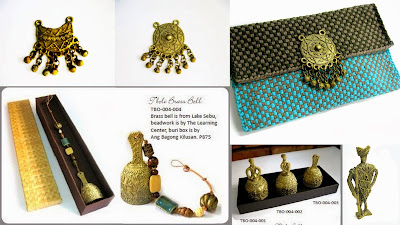
Not in the collage is a set of four brass napkin rings in an elegant T'nalak box, bangles, and jewelry made from braided cloth strips and a brass ring. But we can share these in another blog post.
Here's a photo of Nadeth with her daughter Bon with Fernando Regalado and Jhun Jhun Gementiza of G&G and Mike Panghilason of Heidi's Crafts (weavers of the clutch in the photo) at our Partner's Dinner this year held at the Herald Suites.

Finally, here is a link to further reading on the T'bolis and a link to an online article on loqal.ph
http://lakesebuphilippines.blogspot.com/p/tiboli-tribe.html
http://loqal.ph/home-and-living/2010/08/09/t%E2%80%99boli-women-weave-history-culture-in-t%E2%80%99nalak-cloth/
If you'd like more information or you'd like to order and support this cause, we'd love to hear from you. Please email us at info@giftsandgraces.com or marketing@giftsandgraces.com
We are happy to be part of the effort to share their story, contribute to their livelihood and share their heritage. Last month, Nadeth shared with us their special method of brass casting. While we don't divulge all the details here, we wanted to share part of the story behind the making of the T'boli's beautiful brass items.
1. Prepare the materials

- Yellow brass from scrap material sourced from junk shops
- Beeswax
- Charcoal
- Clay soil with rice hulls
- Cooking/melting pot
2. Prepare the beeswax by melting it, rolling it, and designing it. Note that this is where the intricate designs come in.

3. Prepare the mold by pounding the clay soil with rice hulls, covering the mold with this mixture, melting the wax, leaving the mold out to dry in the sun, and drying it over fire

4. Next, melt the brass in a traditional blower, pour the melted brass into the mold, then allow to cool in a water bath.

5. Break the mold and voila you have your brass bell!

6. Cut and clean the bells. The final stage is cleaning the bells with calamansi

Here are some of the beautiful items made from brass. A brass man, brass bells in regular design and man and women designs, the brass bell with beads from The Learning Center to make our bell charm, and brass pendants which we use with woven retaso for a special line of clutches


Not in the collage is a set of four brass napkin rings in an elegant T'nalak box, bangles, and jewelry made from braided cloth strips and a brass ring. But we can share these in another blog post.
Here's a photo of Nadeth with her daughter Bon with Fernando Regalado and Jhun Jhun Gementiza of G&G and Mike Panghilason of Heidi's Crafts (weavers of the clutch in the photo) at our Partner's Dinner this year held at the Herald Suites.

Finally, here is a link to further reading on the T'bolis and a link to an online article on loqal.ph
http://lakesebuphilippines.blogspot.com/p/tiboli-tribe.html
http://loqal.ph/home-and-living/2010/08/09/t%E2%80%99boli-women-weave-history-culture-in-t%E2%80%99nalak-cloth/
If you'd like more information or you'd like to order and support this cause, we'd love to hear from you. Please email us at info@giftsandgraces.com or marketing@giftsandgraces.com
Subscribe to:
Posts (Atom)